Retrofuturism: the future as envisioned by the past
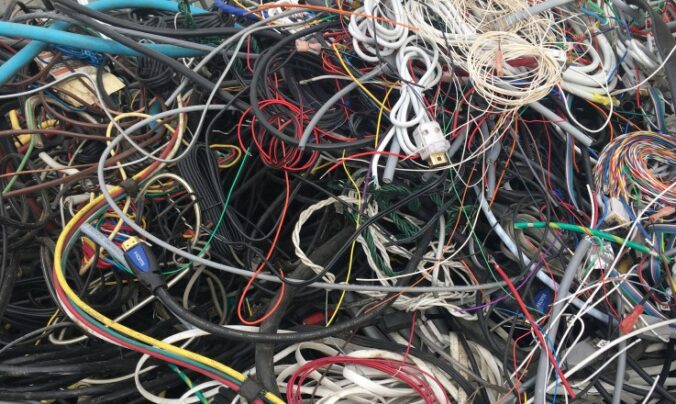
Cyberpunk tech is dated, like the steam and clockwork in Steampunk, and the dystopia it warned us against already arrived.
When writer Bruce Bethke coined the term cyberpunk in the ’80s, it marked the beginning of a predictive genre that speculated on a world of clunky hardware, wires, virtual reality, and a dystopia where corporations run amok in a globalist hellscape. In 2021, life is more strange than any cyberpunk author foresaw, and technology exponentially more advanced. The ethical questions raised around corporate welfare, transhumanism, and police and surveillance states, are all as relevant today as they were when they were written, but we are answering them as they play out instead of answering them preemptively.
William Gibson, a writer who shaped the genre and coined the word “cyberspace,” said that science fiction is more about the anxieties of the time it’s written in than it is the future. In his article Will We Plug Chips Into Our Brains?, he speculates we won’t have cybernetics like the characters in his stories Johnny Mnemonic or Neuromancer. Instead, everything will be augmented. Gibson says: “Our hardware, I think, is likely to turn into something like us a lot faster than we are likely to turn into something like our hardware.” He argues the merger of tech and biology will create a smart and interactive world where computation is indistinguishable from our environment.
This is already happening. Our hardware is exponentially shrinking. We currently have non-invasive tech that can image your brain to enhance focus, genetically modified bacteria that can target cancer, and we can see what someone’s eyes are seeing, and programmers are coding AI that will eventually replace them. Google has claimed quantum supremacy, and scientists predict the public will have access to quantum computing in ten years. In fact, you can already download software to emulate a quantum computer on your current computer. SpaceX’s Starlink aims to provide internet connection anywhere on the globe, and if they don’t manage it, someone else is likely to. That a private corporation is monopolizing infrastructure that should be publicly controlled is just another example of the dystopia we’re already in.
“Our hardware, I think, is likely to turn into something like us a lot faster than we are likely to turn into something like our hardware.” –William Gibson

Xenobot swarm activity. Photo taken from scitechdaily.com, credit: Doug Blackiston, Tufts University
Xenobots 2.0 are frog stem cells, programmed through a simulated virtual evolution. They are teaching us a lot about what cells are and aren’t programmed to do, and providing us with potentially self-healing biological machines that can record data and synthesize chemicals and proteins. They could possibly scrub micro plastics from the oceans, secrete insulin for diabetics, or help terraform Mars. Combine these implications and you have biology-based tech that can read your mind, monitor your body, and serve up a solution without you having to ask.
We will not live in the cyberpunk world of bulky mechanical arms, cybernetic enhancements, or cumbersome VR goggles. We’ll regrow limbs. We’ll hack our genome to be more efficient. A tiny, non-invasive device will speak to the neurons in our retinas, to the pyramidal cells in our hippocampus to augment our vision and trick our sense of spatial awareness with the speed of a quantum computer. That’s if we don’t all die in a climate catastrophe first.
That covers the tech. What about the dystopia?
Corporate Welfare
Law can not keep up with tech, and the tech industry lobbies the government, slowing it down even further. It’s a slow moving, reactive–not proactive-–body, where corruption is an open secret. The Fourth Amendment and current antitrust law have not stopped Big Data from tracking our every move, or the NSA from illegal surveillance on U.S. citizens.
Globalism is complicated, as are most things. We see manufacturing moving to underdeveloped nations (i.e. nations deliberately robbed of resources via colonialism) taking typically unionized and stable jobs away from the U.S. working class, while increasing the standard of living in other nations. However, in China, working conditions are so poor, some workers would rather kill themselves than make iPhones. There is an often tragic and hidden cost to our comforts. Historically, the greater someone’s comfort, the greater the human suffering needed to maintain it.
Meanwhile in the U.S., the gap between the poor and rich widens as programmers in Silicon Valley admit to coding their own AI replacements. Some of them are so worried about the civil unrest that will come from automations, knowing there’s no social safety net in place in our country for when our jobs disappear, that they’re building bunkers. The U.S. props up a special, insidious breed of capitalism, a fascism 2.0. It’s an individualistic, toxic Puritan work ethic with an undercurrent of eugenics, Christian and white supremacy, and social darwinism. If you’re sick, you must have done something to deserve it. If you’re rich, you must be a genius–-let’s disregard generational wealth or privilege. If you’re poor, it’s because you don’t work hard enough, not because of institutional ableism, classism, sexism, racism, agism, or any other prejudice.
Poor conservatives defend the rich and support policy that goes against their best interest, because they believe they’ll be rich one day. With the same vehemence, white, able-bodied, cisgendered, heterosexual, neurotypical, non-traumatized, middle-upperclass men defend Elon Musk in the dark recesses of Twitter because they believe the status quo serves them–-that their billionaire buddy Elon will take them to Mars. But in reality, Elon Musk doesn’t care about them. Billionaires don’t get to be billionaires by being kind or intelligent or resourceful, but by exploitation and generational wealth. Wealth does not trickle down, they are not sharing. There’s not as much social mobility as people tend to believe.
Large corporations receive government bailouts, and through campaign donations at every level of government, they stifle competition. Those that tout laissez-faire capitalism tend to ignore the reality of corporate welfare. The market does not “sort itself out.” Yet individuals must take on an insurmountable amount of debt for higher education because the well-paying manufacturing jobs that don’t require a degree are vanishing. We don’t have health insurance outside of an employer, and companies big and small are exploitative by their very nature. COVID-19 has underscored this recently: small businesses suffer, large ones flourish. Small and large businesses alike pressure employees to return to unsafe conditions and bemoan that some of them would rather remain on unemployment–-a benefit under constant threat–-than return to work and expose themselves in a pandemic. We pay into unemployment via taxes, it is our money to get back. Large corporations avoid paying taxes and want us to feel shame for using the social programs we built.
Tech Monopolies
Tech has improved our lives in so many ways, but has also brought with it a slew of ethical issues.
Dark Design is deliberately built to keep you addicted. iPhones, social media, games, even streaming services fight for your attention. Advertising is more prevalent than ever before, and even if you don’t click through, they can sell your data. Facebook and Google know everything about you and do not delete your information when you delete your account. Infinite scrolling will keep you in an app for hours longer than you intended. We face the toxic individualism of our culture with these problems: big corporations propagandize that you are responsible for your own actions–-if you can’t resist their design built by armies of psychologists, UX designers, market researchers and heaps of cash, well… that’s a personal fault and weakness that you need to overcome. They give a Jedi hand wave and tell you these technologies do not need to be regulated. Most people internalize this as shame and use it as a metric to judge others.
Why is it bad to spend this much time online? The average American spends 17 hours a day in front of a screen (pre-COVID). This brings dystopias such as A Brave New World, 1984, and Fahrenheit 451 to mind, but a lot of cyberpunk seemed to underestimate just how long we would spend “jacked-in.” And what do we do while we’re bouncing from one screen to the next? We sit. Many studies have shown sitting this much is bad for your health. Some might view a desk job as easier on the body than manual labor, and it is, comparatively. However, it’s very damaging in its own right. The humans of Pixar’s Wall-E come to mind. Though not cyberpunk, the cultural critique is relevant.
It’s also detrimental to our mental health, privacy, and autonomy. Facebook has run experiments serving people bad news to determine the impact on their moods. They serve up propaganda that has harmed democracy in the 2016 election and conspiracy theories that threatened public health in 2020-2021. Combine this with their dark design patterns, advertising model, and their legal big data tracking (and they can sell the data they have on you to undisclosed third parties), and you have a brain hack potentially more potent than the Puppet Master in Ghost in the Shell. I mentioned earlier that tech can scan your brain to essentially read your mind. Imagine a corporation like Facebook having access to this data. Well, they’re building it. This is not science fiction, hyperbole, or a conspiracy theory. We can, in a sense, read minds. While this has amazing applications for disabled people, we also must contend with the fact large corporations do not have noble agendas in a for-profit healthcare system.
I’m just grazing the surface here. The dangers of unregulated tech monopolies could fill volumes of encyclopedia-sized books.
Police and Surveillance State
In cyberpunk, corporations and government are hardly distinguishable, if at all. Police are militarized and protect corporate interests over the interest of the people. Democracy is a facade, resources are hoarded, and everything is privatized. Maybe when Snow Crash was released in 1992 this was a cautionary tale, though one could argue the U.S. has been on a steady path to corporatism since Reagan (or much longer). But in 2021, this is simply how it is.
We’ve watched police execute black men and women on the street, and in their own homes, with no justification. They rape women in their custody, use excessive force against the mentally ill, and face no accountability. During protests in 2020, we watched police in riot gear beat foreign journalists and unarmed demonstrators who complied with arrest, and corral protestors that were legally present into cars disguised as cabs under false pretenses. Activists can speak to the militarization of police much more eloquently than I can. My main point is that cyberpunk, and any fiction dealing with this topic, must adjust for our present circumstances. This is not a fun trope to brush over simply to give your underdog character an obstacle. This is real life, with real consequences that disproportionally effect minorities.
Edward Snowden exposed the NSA’s mass surveillance program in 2013, but whistles were blown in 2005 and earlier. In 2020, the court ruled the program was illegal. The process took 15 years, and it does not put a stop to all unconstitutional surveillance. Private contractors work with the government, and the government can subpoena tech companies for their data, which further blurs the lines on what the U.S. government can track. Foreign governments can also make deals with big tech, and one tech giant can gather a pool of sensitive, private data from around the globe. How much of it they share–-voluntarily, by force, or by espionage–-is unclear.
What’s next for cyberpunk?
I love the genre, and it’s still viable. My argument is that it’s no longer predictive, and greater care should be taken to portray the disenfranchised. The heady philosophical questions raised by the genre go beyond aesthetic and trope, and that’s what makes the best works of the genre so enduring.
As Gibson said, science fiction is more about the anxieties of the time it’s written in. Cyberpunk is an alternate future envisioned at the dawn of personal computers and internet, during Reaganomics and the disappearing middle class, the Cold War, and global warming (just to name a few anxieties) in the 80’s and 90’s. If hardware based technology had been as powerful as cyberpunk predicted, it would have been obsolete as soon as it was useful.
Post-cyberpunk deconstructs some of the cynicism of the genre, and there are dozens more genres with “–punk” tacked onto the end to indicate progression. Whatever the sub-sub-genre, there will always be room in my heart for cyborgs, grumpy detectives, neon, and autonomy seeking AI. It’s just not the future anymore.